Cousins, explained: seconds, thirds, and 'removed'
The rule is simpler than it sounds: the number tells you which ancestor you share, and "removed" tells you how many generations apart you are. First cousins share grandparents. Second cousins share great-grandparents. Third cousins share great-great-grandparents. And any time two people are on the same cousin line but different generations, each step of difference adds one "removed."
The two questions that settle it
- Which ancestor do you share? Grandparents make you first cousins, great-grandparents make you second cousins, and each extra "great" adds one to the number.
- Are you in the same generation? If yes, you are plain cousins. If one of you is a generation closer to the shared ancestor, you are once removed; two generations, twice removed.
The cousin chart
| Relationship | Most recent shared ancestor | Generations |
|---|---|---|
| Siblings | Parents | Same generation |
| First cousins | Grandparents | Same generation |
| Second cousins | Great-grandparents | Same generation |
| Third cousins | Great-great-grandparents | Same generation |
| First cousin once removed | Grandparents / great-grandparents | One generation apart |
| Second cousin once removed | Great-grandparents / great-great-grandparents | One generation apart |
| First cousin twice removed | Grandparents / great-great-grandparents | Two generations apart |
A worked example
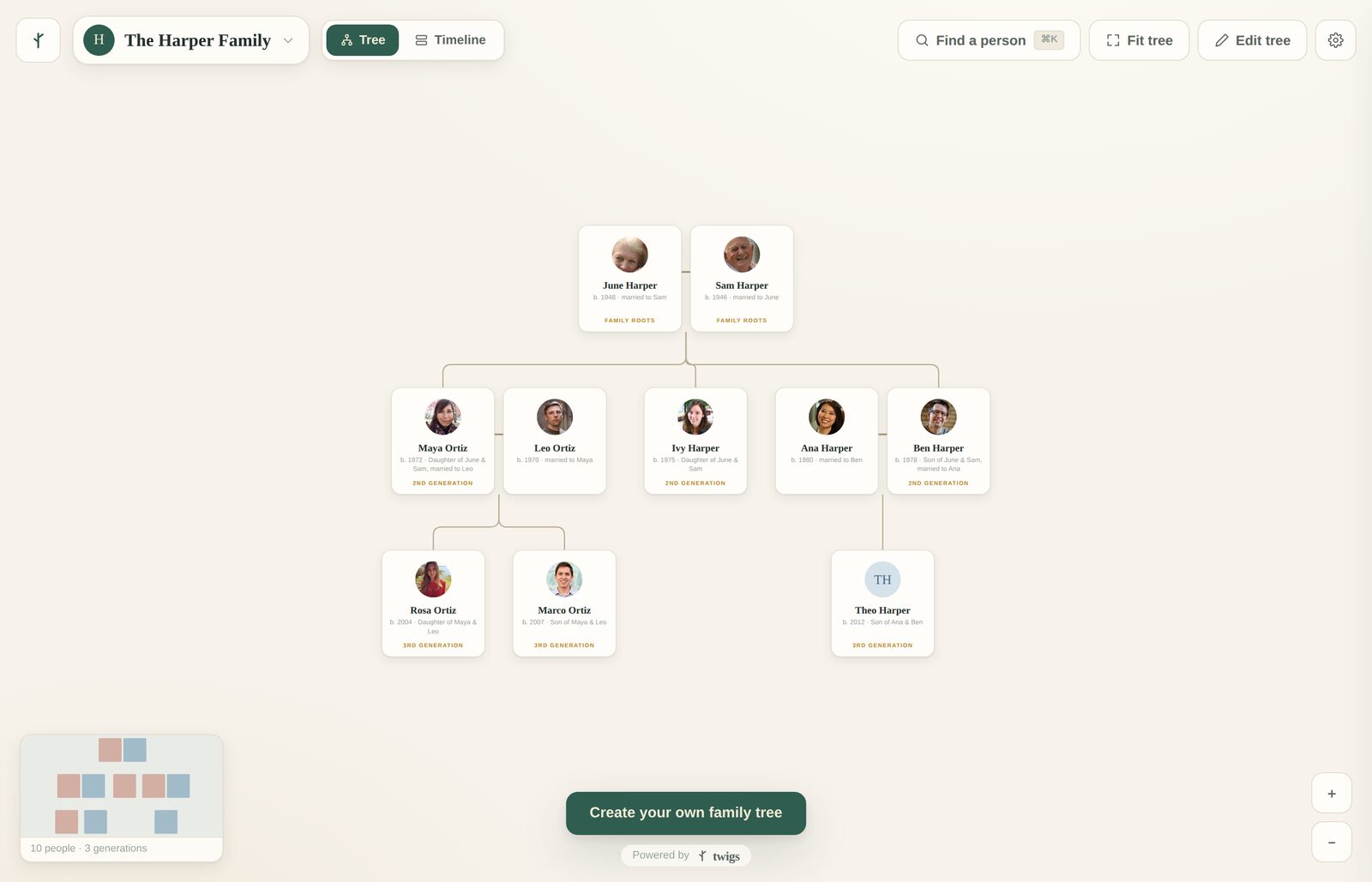
Take the Harpers, the demo family on Twigs. June and Sam's daughters Maya and Ivy are siblings. Maya's children (Rosa and Marco) and Ben's son Theo are first cousins: their shared ancestors are June and Sam, their grandparents. If Rosa one day has a child, that child and Theo will be first cousins once removed, and Rosa's child and Theo's future children would be second cousins, sharing June and Sam as great-grandparents.
Common questions
What is a second cousin?
Second cousins share great-grandparents. Your parent's first cousin's child is your second cousin: you're in the same generation, but the ancestor you share is one level further back than for first cousins.
What does 'once removed' mean?
'Removed' counts the generation gap between you. Your first cousin's child is your first cousin once removed, and so is your parent's first cousin. Same cousin line, one generation apart.
What is the difference between a second cousin and a first cousin once removed?
A second cousin is in your generation and shares your great-grandparents. A first cousin once removed is one generation above or below you on the first-cousin line, either your parent's first cousin or your first cousin's child.
What do I call my cousin's child?
Your cousin's child is your first cousin once removed. Informally, many families just say niece or nephew, and 'cousin' covers everyone at the reunion, which is also fine.
Are third cousins really family?
Third cousins share great-great-grandparents. Genetically the overlap is small, but family is what you keep: if you know your third cousins by name, that is a family worth putting on a tree.
See it instead of counting it
Cousin math gets easy the moment you can look at the tree: find the shared ancestor, count the "greats," compare the rows. Twigs lays your family out exactly that way, zoomable on any phone, private behind your family's password, and free to start.